CG Policy · 2025
In this section7 topics
Corporate Governance Policy
Has a Corporate Governance Policy
Yes
Policy Description
The Company recognizes the importance of good corporate governance as a crucial mechanism for building confidence, enhancing competitiveness, and supporting long-term sustainable growth. Therefore, it is committed to conducting business with transparency, fairness, and responsibility towards society, communities, and the environment, under the framework of the company's policies and business ethics.
The Board of Directors acts as a leader and a good role model in adhering to good corporate governance principles by establishing appropriate policies, practices, and governance mechanisms to ensure the company's operations are ethical, transparent, and auditable, coupled with effective risk management and internal controls. It also promotes an organizational culture committed to ethics, responsibility, and compliance with relevant laws and regulations, so that employees at all levels participate concretely in driving good corporate governance.
The Board of Directors has appointed a Corporate Governance Sub-Committee to oversee, supervise, and monitor operations in accordance with the Company's corporate governance policy, as well as to support the development of governance practices that are appropriate and consistent with business changes, to create long-term value and sustainability for the Company.
In this regard, the company has compiled and developed policies, practices, and criteria related to good corporate governance to serve as a framework for the operations of the Board of Directors, executives, and employees at all levels, ensuring consistency, standards, transparency, and auditability. Stakeholders can study the details of these policies and practices via the attached link.
The Company has established a written Good Corporate Governance Policy since 2017 and reviews it annually. It comprises 8 appropriate principles for the Board of Directors to adhere to, as follows:
Principle 1: Recognize the role and responsibilities of the Board of Directors as leaders who create sustainable value for the enterprise.
The Board of Directors understands and recognizes its roles, duties, and responsibilities as organizational leaders who must oversee good organizational management, ensuring the company's business operations are transparent and lead to sustainability. The roles, duties, and responsibilities of the Board of Directors have the following guidelines for practice:
Define the company's objectives, main business goals, vision, and mission, and communicate them to employees so that everyone shares a common purpose and is committed to building an organization that achieves sustainable value creation in terms of environment, society, and governance, considering all stakeholder groups.
Annually define and review the company's operational policies, plans, and budgets to align with business direction and strategies. This includes monitoring and evaluating the company's performance, considering competitiveness, technology industry trends, and both short-term and long-term business impacts. This is to enable management to utilize recommendations for further developing and improving the company's operational efficiency and appropriately adapting to changes in business environmental factors.
Clearly define the scope of duties and responsibilities of the Board of Directors according to the Directors' Handbook and the charters of each sub-committee, and review them annually, to ensure that directors and executives perform their duties with responsibility, diligence, and integrity towards the organization, and can act correctly and appropriately. Furthermore, clearly define the roles and responsibilities between the Board of Directors and management to ensure operations comply with laws, regulations, shareholder resolutions, and established guidelines, and regularly communicate these roles and responsibilities to directors, sub-committee members, management, and employees at all levels.
Establish strategies, policies, various procedures, and a business code of conduct for directors, executives, and employees to cover all company operations. This includes holding Board meetings to monitor the performance of management at least once a year to ensure the company's strategies are implemented. Various policies are compiled into a Corporate Governance Handbook to serve as a guide for ethical operations, respecting the rights and responsibilities towards shareholders and all stakeholders, based on correctness and appropriateness, in accordance with good corporate governance principles. Furthermore, act as a good role model as a leader in corporate governance.
Board of Directors meetings are held at least once every three months, and shareholder meetings are held within four months from the end of the company's accounting period. Extraordinary general meetings of shareholders are convened as necessary for business operations.
The company is required to have appropriate, robust, and effective internal control, internal audit, and enterprise risk management systems. Furthermore, the Board of Directors meetings continuously and consistently monitor operations on various matters.
The Board of Directors appoints the Company Secretary and clearly defines the scope of authority, duties, and responsibilities of the Company Secretary to ensure performance with responsibility, prudence, and integrity, in accordance with good corporate governance principles.
The Company's corporate governance structure, which covers organizational management from the Board of Directors, sub-committees, management, as well as various units acting as mechanisms for corporate governance, is detailed in the diagram titled "Good Corporate Governance Structure."
Principle 2: Establish the company's main objectives and goals for sustainability.
The Board of Directors emphasizes establishing the company's main objectives and goals that support sustainable growth, collaboratively defining and reviewing the vision, mission, and business strategies to align with changing economic, social, and environmental trends, to create long-term value for the company, shareholders, and all stakeholder groups.
The Board of Directors has established clear operational goals for the short, medium, and long term, along with developing annual work plans and actionable operational frameworks. This involves considering market competition, potential risk factors, and past performance, as well as continuously monitoring, evaluating, and reviewing operational progress to achieve the defined goals.
In performing their duties, the Board of Directors maintains independence in expressing opinions, acts with integrity, does not seek personal gain, and avoids actions that may create conflicts of interest with the company or its subsidiaries. Furthermore, they support the adoption of appropriate, safe, and responsible innovation and technology in business operations to enhance competitiveness and drive the organization's stable and sustainable long-term growth.
Principle 3: Strengthen an Effective Board.
The Board of Directors recognizes its significant role in overseeing the Company’s operations to ensure the highest benefit to the Company. The Board understands its duties and responsibilities, clearly separating its roles from those of the management team, and ensures confidence in the Company’s transaction systems and business operations that they are conducted in compliance with applicable laws and ethical standards. To ensure that the Board’s performance is both efficient and effective, the Board collectively determines and regularly reviews its structure and strictly adheres to the Board Manual and the charters of each sub-committee. The Company Secretary is responsible for organizing Board meetings, shareholders’ meetings, and other Board-related activities. In addition, the Board oversees the Compliance function to support both the Board and employees in accessing necessary information, ensuring adherence to relevant laws and regulations, and promoting corporate governance practices in accordance with good governance standards.
Principle 4: Recruitment and Development of Senior Executives and Human Resource Management.
The Board of Directors is responsible for the recruitment and development of the Chief Executive Officer and senior executives at all levels, as well as efficient human resource management, with the following guidelines:
Establish guidelines for continuous director knowledge development and regularly evaluate the performance of the Board of Directors and sub-committees.
Develop a succession plan for the organization's top executives in the event of an executive's departure.
The Nomination and Remuneration Committee holds regular annual discussions and has a policy for the nomination and remuneration of directors and various sub-committee members, determining remuneration for directors and executives with prudence, transparency, and in line with good corporate governance principles.
Responsibility and performance to create both short-term and long-term incentives, comparable to industry standards.
Principle 5: Promote Innovation and Responsible Business Operations.
The Board of Directors recognizes the importance of and supports innovation that creates value for the business, alongside generating benefits for customers or related parties, and is responsible towards society and the environment. An Operation Plan is developed to ensure all parties act in alignment with the company's objectives, goals, and strategies, conducting business responsibly, fairly, and considering the interests of all stakeholder groups.
The Company promotes innovation to add value to the business in response to ever-changing environmental factors, and encourages employees to innovate in both processes and product value enhancement, demonstrating creative potential, proposing ideas for new business ventures, and developing innovations until they are protected as the company's intellectual property.
The Company conducts its business alongside social responsibility, without adverse effects on society or the environment, and without violating laws related to the company's principles of social responsibility. The company supports and encourages all employees to continuously participate in social responsibility, and focuses on enhancing the potential of children and youth.
The Company efficiently manages resources, considering the impact and development of resources throughout the supply chain, from procurement processes to consumers, who are at the end of the supply chain. This aims to create maximum benefit for all stakeholders to support the stable and sustainable achievement of organizational objectives and goals.
Therefore, the Company requires all employees to share responsibility for using information and communication technology systems under the provisions of relevant laws.
Principle 6: Ensure Appropriate Risk Management and Internal Control Systems.
The Board of Directors is responsible for assessing the adequacy of the internal control system. The company has adopted the internal control system adequacy assessment form, based on the guidelines of the Securities and Exchange Commission, as a tool to evaluate the adequacy of the company's internal controls, following the concept of The Committee of Sponsoring Organizations of the Treadway Commission (COSO), which defines five essential components of internal control, as follows:
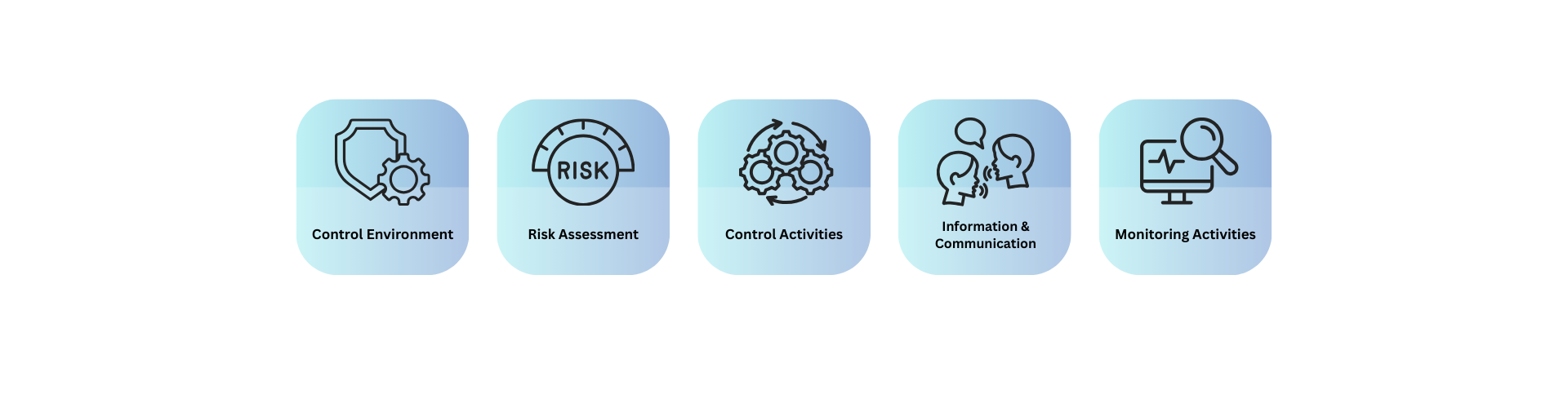
The Company ensures appropriate internal control systems and compliance with relevant laws, regulations, and rules. The Internal Audit Department evaluates and reports results to the Audit Committee before submitting them to the Board of Directors for acknowledgment. Furthermore, clear risk management policies are established, and the Risk Management Sub-Committee is assigned to systematically identify, assess, and manage organizational risks.
The Company emphasizes preventing personal gain and conflicts of interest. The Board of Directors assigns the Audit Committee to oversee related party transactions or transactions that may lead to conflicts of interest, and to prevent the improper use of company assets, information, and opportunities. Such transactions are conducted for the utmost benefit of the company and its shareholders as a whole, and in accordance with relevant laws and regulations.
Furthermore, the company establishes anti-corruption policies and practices based on the principles of "no solicitation, no acceptance, no payment," and no business dealings with those involved in corruption. The Board of Directors oversees, promotes, and sets an example for adherence to this policy, and requires directors, executives, and employees at all levels to collectively prevent and combat all forms of corruption. The company has established whistleblowing channels and has been a member of the Collective Action Coalition Against Corruption (CAC) since 2016.
Principle 7: Maintain Financial Credibility and Information Disclosure.
The Board of Directors recognizes its role in maintaining financial credibility for shareholders and stakeholders by overseeing the financial reporting system, liquidity adequacy, and debt-paying ability through the Audit Committee, which consists of independent directors, to ensure the quality of financial reports and internal control systems. The Board of Directors is jointly responsible for the consolidated financial statements of the company and its subsidiaries, which are prepared in accordance with generally accepted accounting standards in Thailand, with sufficient disclosure of important information, and regular preparation of management's discussion and analysis accompanying the financial statements.
The Company maintains an effective internal control system to ensure that accounting information is accurate, complete, and can prevent fraud or material irregularities, and also has a contingency plan in case the company faces financial difficulties, while considering the rights of stakeholders.
Furthermore, the company emphasizes accurate, transparent, and auditable tax management by establishing tax policies that comply with laws and international standards, utilizing tax benefits appropriately, and not engaging in tax avoidance, to create maximum benefit for all stakeholders.
Information Disclosure.
The Company adheres to relevant laws, rules, and regulations of the SEC and the Stock Exchange of Thailand, with a policy for accurate, sufficient, equal, and timely communication and disclosure of both financial and non-financial information through easily accessible and reliable channels, such as the company website, Form 56-1 One Report, and other communication channels in both Thai and English, to ensure shareholders, investors, analysts, media, and stakeholders receive transparent and complete information.
The Company defines clear roles and responsibilities for communication with shareholders and investors, continuously organizes investor relations activities, provides opportunities to access information and question executives, and establishes a policy for information disclosure and transparency. The Board of Directors regularly oversees and reviews this policy, and also provides channels for complaints and suggestions, to build confidence in transparent and sustainable business operations.
The Company values and respects shareholder rights, promoting shareholders' full and equal exercise of fundamental rights, such as the right to hold, transfer, and receive benefits from shares, the right to attend meetings, propose agenda items and nominate directors, vote in person or by proxy, and access accurate, sufficient, and timely information both before and after meetings through appropriate channels.
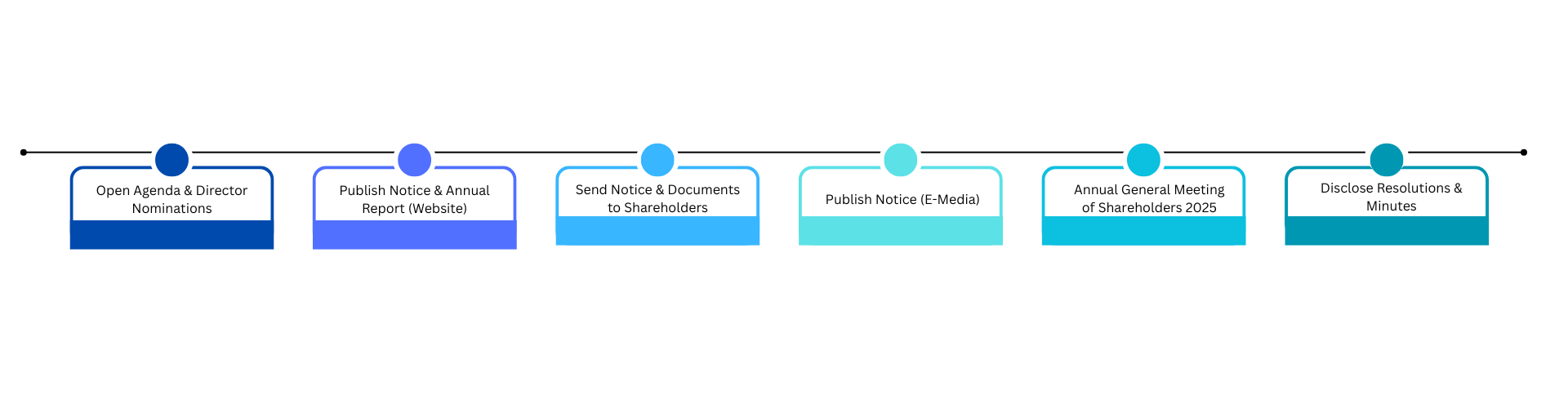
The company organizes annual general meetings of shareholders in accordance with laws, regulations, and good corporate governance principles, to provide shareholders with the opportunity to participate in significant decisions affecting the company, as follows:
Before the meeting.
The Company provides shareholders with the opportunity to propose additional agenda items and/or nominate individuals for election as directors at the annual general meeting, as well as to submit questions in advance of the meeting, from September 1 to November 30, 2024. Shareholders can exercise these rights via email, postal mail, or the company's website.
The Company holds an annual general meeting once a year, within a period not exceeding 4 months from the end of the Company's accounting period. In urgent cases requiring shareholder resolution, the Company will convene an extraordinary general meeting specifically for that purpose. In 2025, the company held its annual general meeting on April 1, 2025, at Metro Systems Corporation Public Company Limited, Head Office, No. 400 Chalermprakiat Rama 9 Road, Nongbon Subdistrict, Prawet District, Bangkok, and no extraordinary general meeting was convened.
The Company published the annual general meeting invitation in both Thai and English, specifying the date, time, venue, agenda, and supporting information for consideration, along with proxy forms A, B, and C as required by law, to facilitate shareholders. The company published this information on its website on March 3, 2025, prior to sending the meeting invitation documents to shareholders, and sent the annual general meeting invitation, including meeting documents and the annual report (One-Report) in QR Code format, to shareholders at least 14 days before the meeting. Additionally, the meeting invitation was advertised in both Thai and English via electronic media for 3 consecutive days prior to the meeting, to ensure shareholders receive accurate and sufficient information and can exercise their rights appropriately at the meeting.
Annual General Meeting of Shareholders Day.
The Company provides a meeting venue that is convenient for traveling to attend the annual general meeting and is sufficiently sized to accommodate the number of shareholders and proxies at the company's head office, No. 400 Chalermprakiat Rama 9 Road, Nongbon Subdistrict, Prawet District, Bangkok.
The company has implemented a barcode registration system, displaying the registration number of each shareholder printed on the registration form and proxy form, to expedite the registration process. Additionally, the company has prepared duty stamps for proxy forms for proxies attending the meeting, along with facilitating staff throughout the registration period.
The Company has established guidelines for the annual general meeting to prevent the deprivation of rights and to facilitate shareholders equally. Shareholders can register to attend the meeting at any time during the meeting to exercise their voting rights on unvoted agenda items, as well as express their opinions freely within a reasonable timeframe.
When the meeting commenced, directors, various sub-committee members, executives, as well as auditors and legal advisors, attended. Before the meeting began, the Chairman assigned a company representative to explain all meeting-related rules, such as opening the meeting and voting procedures, including the method for counting shareholder votes for each agenda item.
The Company uses ballot cards for all agenda items requiring a vote, for transparency and auditability. For the election of directors, individual director elections are held. For each agenda item's voting procedure, the Chairman will ask the meeting if any shareholder or proxy disagrees or abstains. Shareholders or proxies who disagree or abstain are requested to raise their hands and mark their votes on the ballot card, along with their signature. Officials will record the votes by scanning the barcode on the ballot card and collect the cards. Shareholders who agree should mark their votes and sign the ballot card without raising their hands, and the company will collect all "agree" ballot cards simultaneously after the meeting concludes.
For the detailed voting results of each agenda item, the results will be compiled and announced to the meeting after the completion of voting for each item. Once the officials have finished counting the votes, the detailed results will be immediately announced to the meeting.
The Company has a Company Secretary, appointed by the Board of Directors, to act as the vote counter throughout the meeting. Additionally, volunteer representatives from the Thai Investors Association participate as observers to protect shareholder rights.
Shareholders who join the meeting after the Chairman has opened it may cast their votes on agenda items currently under consideration and not yet voted upon. They will be counted as part of the quorum from the agenda item they joined onwards, which may result in an unequal number of eligible voters for each agenda item.
At the annual general meeting, if any director has a conflict of interest in a particular agenda item, that director must inform the meeting to abstain from voting and not participate in that specific agenda item.
The meeting will consider matters in the order of the agenda specified in the notice of meeting without any changes to the agenda order, and no other matters beyond those specified in the notice of meeting will be considered. After the meeting has fully considered all agenda items, the Chairman will provide an opportunity for shareholders to ask additional questions on matters of interest before closing the meeting.
After the Annual General Meeting of Shareholders.
The Company disclosed the resolutions of the annual general meeting by notifying the Stock Exchange of Thailand (SET) on the same day after the meeting concluded, and published the resolutions on the company's website within the next business day. The annual general meeting minutes were prepared with clear agenda items, specifying the names of directors attending/not attending, shareholder questions, Board explanations, vote counting, and complete voting results for each agenda item, and submitted to the Stock Exchange of Thailand (SET) within 14 days after the meeting, as per SET regulations. The detailed meeting records were appropriately published, and the meeting report was made available to shareholders on the company's website ( www.metrosystems.co.th )
Policy & Practices — Board of Directors
Has Policy & Guidelines for the Board
Yes
Board Guidelines
| Guideline | Other — Please Specify | Detail |
|---|---|---|
| Nomination of Directors | The Board of Directors has considered and assigned the Nomination and Remuneration Committee to deliberate on the criteria and methods for selecting qualified individuals to hold the position of Chief Executive Officer, and to propose suitable candidates with justifications for the Board of Directors' consideration and appointment. The following criteria have been established for the selection process:
Subsequently, the Nominating and Remuneration Committee will present the list of candidates along with justifications to the Board of Directors for further consideration and appointment. | |
| Determination of Director Remuneration | The Nominating and Remuneration Sub-Committee is responsible for determining the remuneration of directors, meticulously scrutinizing various aspects of suitability. Directors' remuneration will be based on their experience, duties, scope of roles and responsibilities, and benchmarked against comparable industries, while also considering the company's business expansion and profit growth. The directors' remuneration will adhere to the principles and policies established by the Board of Directors, within the framework approved by the shareholders' meeting (for remuneration types requiring approval from the shareholders' meeting). | |
| Independence of the Board of Directors from the Management | The Company mandates the Board of Directors to perform its oversight duties independently from management, in accordance with good corporate governance principles. This is achieved by separating the roles and responsibilities between the Chairman, who is responsible for policy setting, and the Chief Executive Officer, who is responsible for operational management. To enable directors to perform their duties independently within their scope of authority and effectively oversee and evaluate management performance, the Company has established a policy that the Chairman and the Chief Executive Officer must be different individuals. Both positions must be selected by the Board of Directors through a screening process by the Nominating and Remuneration Sub-Committee, and compensation is determined to ensure the selection of individuals with complete qualifications and the highest suitability. In cases where the Chairman is not an independent director, the Company has clear measures to balance power between the Board of Directors and management, by assigning independent directors to jointly consider and determine the agenda for Board of Directors meetings. Furthermore, the Board of Directors has clearly approved the scope of authority for executives to ensure transparency and appropriate operational flexibility. They also have the duty to control expenses and investment budgets within the limits approved by the Board of Directors in the annual work plan, implement human resources policies, and resolve problems or conflicts affecting the organization. | |
| Director Development | The Company promotes and facilitates continuous training and knowledge provision to the Board of Directors, sub-committees, executives, the company secretary, as well as directors of subsidiaries, to foster new knowledge and ideas for continuous application and adaptation to the company's business operations. This training and knowledge provision is conducted both internally within the company and through external institutions. Directors must complete the basic training courses of the Thai Institute of Directors (IOD), including other courses from the Securities and Exchange Commission, the Stock Exchange of Thailand, the Thai Investors Association, the Thai Institute of Directors, or other independent organizations. The company secretary will coordinate with the directors to inform them of various training courses to enhance their knowledge and benefit their performance of duties. | |
| Board Performance Evaluation | The Company has a policy to arrange for the Board of Directors to conduct annual self-assessments of their performance, utilizing a performance evaluation form from the Stock Exchange of Thailand adapted to suit the Company. This enables the Board to review their performance and any obstacles encountered during the past year. The Company Secretary will distribute the Board performance evaluation form to all directors for their annual performance assessment, both as a committee and individually. The Company Secretary will then collect these evaluation results from the directors, summarize the scores, and analyze the Board's performance evaluation. The Board meeting will be informed of the performance and any issues, and the conclusions drawn will be used to further improve the Board's performance of duties. Furthermore, the Company has a policy for its sub-committees to conduct self-assessments of their annual performance. This serves as a framework for reviewing their operations over the past year, enabling them to address issues and enhance work efficiency. The evaluation results are then presented to the Board of Directors' meeting for acknowledgment. | |
| Corporate Governance of Subsidiaries and Associated Companies | The Company has established a policy for supervising the operations of its subsidiaries and associated companies to ensure that management aligns with the Company's direction, under the principles of good corporate governance, transparency, and accountability. The Company stipulates the appointment of directors proportionate to shareholding, along with assigning duties to oversee the establishment of internal control systems, risk management, and appropriate prevention of conflicts of interest, as well as requiring regular reporting of operational results and financial information so that the Company can monitor and supervise effectively. Furthermore, subsidiaries and associated companies must comply with regulations regarding connected transactions, information disclosure, and the protection of inside information, similar to the parent company, to ensure transparent operations and compliance with relevant laws and regulations, and to stipulate that such policies be regularly reviewed. | |
| Other guidelines regarding the board of directors | Compliance with good corporate governance principles in other matters | The Company is committed to upholding the principles of good corporate governance by adhering to relevant laws, regulations, and requirements, including the "Code of Best Practices for Directors of Listed Companies" and the guidelines for good corporate governance provided by the Stock Exchange. The Board of Directors has a process for adopting the Corporate Governance Code for listed companies 2017 ("CG Code") as a framework for conduct, in addition to what is already practiced under the Corporate Governance Principle for listed companies 2012 ("CG Principle"). The Company has prepared a Good Corporate Governance Handbook to serve as a guideline for good practices regarding ethics and code of conduct in business operations for directors, executives, and employees. This handbook will be submitted to the Corporate Governance Sub-Committee for regular review at least once a year before being proposed to the Board of Directors' meeting for approval, and will then be communicated to directors and executives for strict adherence. |
Code of Conduct
Has a Business Code of Conduct
Yes
Code of Conduct Description
The Company establishes a Business Code of Conduct as a crucial operational framework, encompassing clear principles and guidelines to ensure strict adherence by directors, executives, and employees at all levels, in line with the principles of Good Corporate Governance, and committed to respecting the rights of all stakeholder groups equally, fairly, transparently, and accountably.
The Board of Directors and senior executives recognize their role as ethical leaders by setting an example in operating with honesty, fairness, transparency, and accountability, while promoting an organizational culture that adheres to morality, ethics, and social responsibility.
The Company prioritizes the continuous development of knowledge, capabilities, and the cultivation of ethical awareness among its personnel through an online system that requires directors, executives, and employees to study important policies such as the Corporate Governance and Business Ethics Policy, the Anti-Corruption Policy, and other related policies, along with confirming their acknowledgment and adherence.
The Company regularly reviews and updates important policies annually to align with business contexts, laws, and practices at both national and international levels, disseminating information through the company's website to ensure convenient and transparent access for stakeholders and the public.
For the year 2025, the company's directors and executives have not committed any offenses or violated any laws that would lead to criminal action, civil sanctions, or administrative action, and there have been no cases of misconduct related to corporate governance and business ethics.
Code of Conduct Practices
| Guideline | Other — Please Specify | Detail |
|---|---|---|
| Prevention of Misuse of Inside Information | The Company has consistently prioritized compliance with securities and exchange laws, regulations, announcements, orders, or requirements of the Stock Exchange regarding connected transactions. As business dealings between the Company, its subsidiaries, associates, or connected persons may give rise to conflicts of interest, the Company has therefore established criteria and procedures for entering into connected transactions to be in accordance with normal commercial terms and market prices, to ensure that decisions to enter into such transactions are transparent and in compliance with the law. Furthermore, the Company has established policies and procedures for entering into connected transactions, ensuring compliance with good corporate governance principles and the announcements of the Stock Exchange of Thailand. Moreover, to ensure that all connected transactions of the Company, its subsidiaries, or associates are transparent, free from any conflicts of interest, and fair to all shareholders equally. | |
| Anti-corruption | The Company is committed to conducting business with transparency, fairness, and accountability under good corporate governance principles. It prioritizes combating corruption and bribery in all forms, both direct and indirect, regardless of whether such actions would benefit the Company, its employees, or any related parties. The Company does not tolerate corruption or bribery in its business operations, prohibiting directors, executives, and employees at all levels from making or offering to make payments, provide assets, or any benefits to induce or exchange for obtaining illegitimate business benefits. This includes prohibiting the giving or receiving of bribes from government officials or private sector individuals, both domestically and internationally. Furthermore, the Company aims to instill and promote anti-corruption as an integral part of its organizational culture by encouraging personnel at all levels to be aware of preventing and combating corruption. Additionally, all employees are mandated to strictly adhere to relevant laws, rules, regulations, and policies. | |
| Whistleblowing and Protection of Whistleblowers | The Company conducts its business under the principles of good corporate governance, considering the rights and equal treatment of all stakeholders. Therefore, the company has established a Whistleblower System that complies with international standards to provide an opportunity for both internal and external stakeholders to transparently and securely report information, complaints, or incidents that may constitute inappropriate conduct, including human rights violations. The purpose of this system is to promote business operations that are correct, transparent, auditable, and to allow stakeholders to participate effectively in the governance and protection of the company's interests. The company has designated the following channels for reporting: Channels for Reporting Clues or Complaints If anyone observes actions suspected of corruption, actions that constitute a conflict of interest, illegal acts, violations of good corporate governance principles, non-compliance with the company's code of conduct, disrespect for human rights, inaccurate financial reporting, or deficient internal control systems, you may inquire or report to the responsible parties as follows:
Furthermore, the Company has designated its Compliance unit, operating under the Company Secretary Department, to serve as the complaint receiving unit for any behavior or incidents that may violate the company's rules and policies, or any suspicious conduct that contradicts the principles established by the company as mentioned above. You can report clues or complaints directly as follows: a) Mail: Company Secretary, Metro Systems Corporation Public Company Limited No. 400 Chalermprakiat Rama IX Road, Nongbon Sub-district, Prawet District, Bangkok 10250 b) Telephone: 020894124 c) E-mail: Corporatesecretary@metrosystems.co.th d) Company Website: https://www.metrosystems.co.th/th/governance/whistleblowing-and-complaints However, any complainant or whistleblower must not report false information or act with malicious intent to harass or intentionally cause damage. In the case of a company employee, disciplinary action will be taken in accordance with the company's regulations. However, if an external party commits such an act and causes damage to the company, the company will consider legal action against such individuals. | |
| Preventing the Misuse of Inside Information | The Company prioritizes the use of inside information, having established written guidelines for its use in the internal control manual to ensure a clear understanding of correct practices. The Company prohibits directors from using material inside information that has not yet been disclosed to the public for their own benefit or the benefit of others, including trading the Company's securities. Directors with knowledge of inside information are prohibited from trading the Company's securities during the 1-month period prior to the public disclosure of financial statements and must wait at least 24 hours after the information has been disclosed before they can trade the Company's securities. The Company will inform its directors and executives of the periods during which they should refrain from trading the Company's securities. Furthermore, the Company emphasizes the protection of confidential customer information, ensuring it is not used for the benefit of directors or related parties, unless such disclosure is required by law. It also prioritizes the security of information in its information systems by controlling and/or preventing unauthorized access to Company data by external parties and by assigning data access rights to employees at various levels according to their duties and responsibilities. Additionally, the Company has a policy that relevant individuals should only be privy to information necessary for their work, ensuring that important data is used and stored carefully and cautiously. Any disclosure of information must be authorized by the executive of the relevant department. In cases where external parties are involved in ad-hoc work concerning non-public information that is currently under negotiation, which falls under the category of inside information that could affect the Company's stock price movements, such individuals must sign a Confidentiality Agreement until the information is disclosed to the Stock Exchange and the Securities and Exchange Commission. The Company requires directors, managers, executives, and auditors to prepare and report changes in their securities holdings, as well as those of their spouses or cohabiting partners, and minor children, to the Company Secretary. This report must be prepared and submitted within 30 business days after assuming their positions. Furthermore, directors and senior executives must notify the Company of every purchase or sale of the Company's securities, with such notification given at least 1 day in advance of the transaction to the Board of Directors or a person designated by the Board, for reporting to the Securities and Exchange Commission within 3 business days of the purchase or sale of securities, and to strictly comply with the Securities and Exchange Act B.E. 2559 (2016). | |
| Giving or receiving gifts, entertainment, or business entertainment | The Company is committed to conducting business with transparency and upholding anti-corruption principles in all forms. It promotes awareness among personnel at all levels and encourages collective efforts to seriously prevent corruption risks. The company has established clear guidelines concerning the giving or receiving of gifts, providing financial support, and charitable donations, to ensure that operations strictly comply with relevant laws, regulations, and rules. Furthermore, all employees are required to strictly adhere to these guidelines to maintain the organization's ethical standards and credibility. | |
| Compliance with laws, rules and regulations | The Company requires all directors, executives, and employees to perform their duties responsibly, by strictly adhering to and complying with laws, regulations, rules, announcements, and requirements related to business operations. All decisions and operational steps must strictly adhere to the framework of laws and company policies, be transparent, and auditable. All personnel at all levels must avoid any actions that may violate laws or company regulations, including not participating in, supporting, or consenting to any form of unlawful acts. They must also cooperate in supervision and compliance with internal control measures to sustainably maintain good corporate governance standards and the organization's credibility. | |
| Use and maintenance of data and assets | The Company places importance on the careful and responsible use and maintenance of its assets, including organizational data. All employees are required to use the company's assets and resources solely for the benefit of business operations, and not for improper, illegal, or personal gain. Furthermore, all employees must collectively protect, care for, and maintain the company's information, especially business confidential information, preventing its disclosure, use, or unauthorized access, in order to preserve the organization's security, credibility, and maximum benefit. | |
| Anti-competitive | The Company is committed to conducting business with fairness and transparency, rejecting any actions that lead to unfair competition, such as price fixing, excluding competitors, or using dishonest methods to seek benefits. Furthermore, the Company encourages all employees to comply with laws, regulations, and ethical codes related to trade competition, and to avoid behaviors that may damage the trust of partners and customers. The company will strictly investigate and find preventive or corrective measures for actions that violate this code of conduct. | |
| Cyber security | The Company prioritizes the security of information and information technology systems to protect personal data and critical business information from various forms of risk. To ensure continuous and reliable business operations, the company is committed to complying with relevant laws and regulations, such as the Computer-Related Crime Act, and promoting transparent operational standards consistent with good corporate governance principles, thereby building confidence among all stakeholders. | |
| Environmental management | The Company recognizes the importance of contributing to creating a positive impact on society, communities, and the environment, by aiming to conduct business alongside social responsibility and systematic environmental care. It not only focuses on generating economic performance but also prioritizes the reduction of potential impacts from operations and supports activities beneficial to society as a whole. The Company has established an environmental policy to serve as an operational framework for directors and executives to perform their duties ethically, transparently, and in compliance with relevant environmental standards. Furthermore, the Company has undertaken the preparation of its organizational greenhouse gas inventory (Carbon Footprint for Organization: CFO) to systematically assess, monitor, and manage greenhouse gas emissions, and has received certification for its assessment results from the Thailand Greenhouse Gas Management Organization (Public Organization) or TGO. This reflects its commitment to environmental operations in accordance with accepted standards and long-term sustainable development. | |
| Human rights | The Company is committed to conducting business based on universal human rights principles and the Guiding Principles on Business and Human Rights, by treating all employees and stakeholders with respect for human dignity. It considers equality, fairness, and non-discrimination in all processes related to employment, compensation, promotion considerations, and personnel development, to ensure that the company's business operations are free from human rights violations in all forms. Directors, executives, and employees at all levels must strictly adhere to these guidelines. The Company has established a comprehensive Human Rights Due Diligence (HRDD) process to assess, identify, and manage human rights risks that may arise from its business operations, and also regularly monitors and reviews these processes to continuously and sustainably elevate the organization's human rights respect standards. | |
| Occupational health and safety | The Company recognizes the importance of comprehensive management of safety, occupational health, and the working environment. It aims to establish operational standards that strictly comply with relevant laws, regulations, and requirements to ensure the utmost safety for employees, surrounding communities, partners, customers, and all stakeholder groups. Furthermore, the company promotes an organizational culture that prioritizes safety and well-being, alongside sustainable development, to enhance the quality of life and well-being of all involved parties in the long term. | |
| Other guidelines related to business code of conduct | Intellectual Property Rights | The Company requires all directors, executives, and employees to strictly respect and comply with laws, policies, and regulations related to intellectual property, by avoiding any actions that may constitute infringement of others' rights. Intellectual property includes copyrights, patents, trademarks, service marks, trade secrets, as well as information related to inventions, creations, innovations, discoveries, or improvements that have been developed, whether owned by the Company or third parties. Concurrently, the Company places great importance on protecting trade information and intellectual property owned, licensed, or collected by the Company through its business operations. All employees are responsible for maintaining confidentiality, safeguarding, and appropriately utilizing such intellectual property, and for strictly adhering to the Company's data protection policies and measures, to prevent leakage, misuse, or infringement that could cause damage to the organization. |
Promoting Compliance with the Code of Conduct
Promotes Compliance by Directors, Executives and Employees
Yes
Description
The company has established systematic processes and tools for communicating, promoting, and monitoring compliance with the business ethics, to ensure that the Board of Directors, executives, and employees at all levels possess the knowledge and understanding to implement them correctly, as follows:
Communication via Compliance News
Preparation of public relations media in the format of Compliance News monthly, to communicate policies, regulations, guidelines, and relevant legal issues or requirements. This is presented in an easy-to-understand, up-to-date format, linked to actual operations, to continuously raise awareness and foster a culture of good corporate governance.
Development of Online Learning Media (Learning Hub via MSC Portal)
Preparation of Learning Hub in the form of E-Learning video clips published via the MSC Portal system (internal intranet), to allow directors, executives, and employees convenient access to policy content, regulations, and business ethics. The content covers key issues related to ethical and legally compliant business operations.
Knowledge Assessment
Following learning through the Learning Hub, the company requires tests to be conducted to assess knowledge and understanding and to measure the effectiveness of policy, regulation, and guideline awareness. The test results are also used as a tool for continuous monitoring and development of compliance communication efficiency. This process reflects the company's commitment to fostering an organizational culture that adheres to ethics, transparency, and strict legal compliance, to support sustainable business operations in the long term. The details of the aforementioned tests are as follows:
business ethics, policies, and various regulations of the company, to communicate and assess knowledge and understanding of the company's business ethics, policies, and various regulations. The company has set a target for permanent employees to participate in the test and pass the assessment criteria with 80 percent or more. In 2025, employees who participated in the test and met the criteria are as follows:
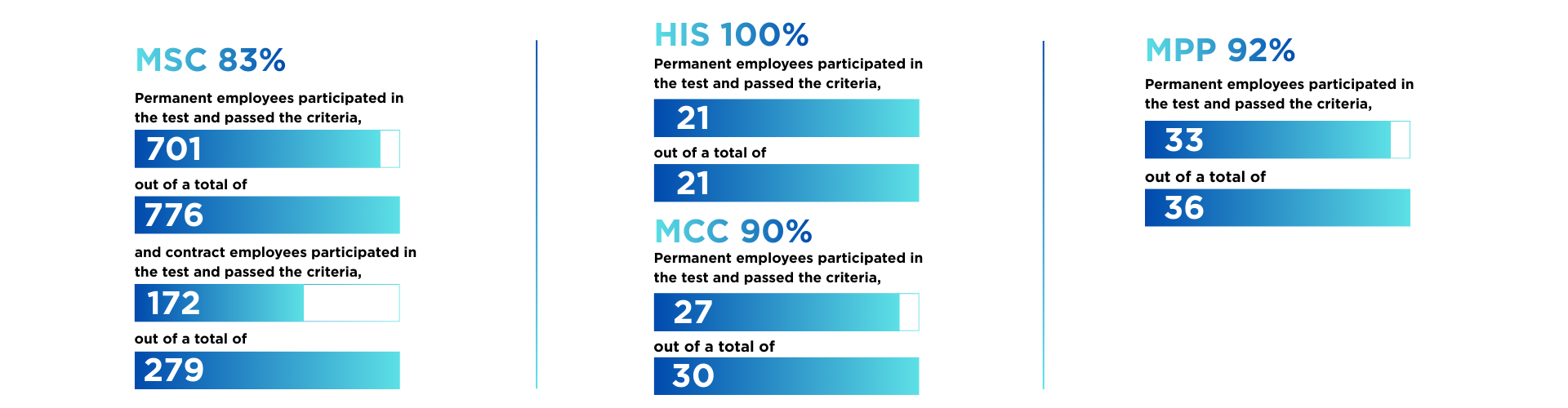
information security in the use of organizational information resources, including various forms of potential cyber threats. The aim is for everyone in the organization to be able to protect themselves and the organization from various threats such as data theft, cyberattacks, or unauthorized data access. The company has set a target for employees to participate in the test and pass the assessment criteria with 80 percent or more. In 2025, employees who participated in the test and met the criteria are as follows:

environmental and occupational health and safety in the workplace, to promote knowledge, understanding, and awareness of the importance of environmental and workplace safety operations, enabling employees to correctly and appropriately apply these principles in their work, in line with the organization's sustainable development guidelines. The results of the training and tests are detailed as follows:

Anti-Corruption Networks & Projects
Joined or Declared Intent to Join Anti-Corruption Networks
Yes
Networks & Projects Joined
| Network / Project | CAC Certified |
|---|---|
| Thai Private Sector Collective Action Against Corruption: CAC | Y |
| United Nations Global Compact (UNGC) | |
| Participation of anti-Corruption networks and initiatives |
Material Changes & Developments in CG
Reviewed the CG Policy or Board Charter in the Past Year
Yes
Material Changes or Developments in the Past Year
Yes
Policy Review — Description
Over the past year, the Company has concretely developed and enhanced its corporate governance system in several dimensions, focusing on strengthening the effectiveness of the Board of Directors, as well as fostering an organizational culture committed to good governance principles, transparency, and accountability to all stakeholder groups.
The Board of Directors has reviewed and clarified its roles, duties, and governance structure by defining the scope of responsibilities between the Board of Directors, executives, and management in accordance with the principles of good corporate governance (Corporate Governance Code: CG Code) on key issues such as equitable treatment of shareholders, and the prevention of insider trading, as well as establishing a framework for responsibilities in the performance of duties by directors and the Chief Executive Officer to ensure comprehensive governance that aligns with the rapidly changing business context.
The Company has reviewed and updated its good corporate governance handbook, business ethics, policies, and sub-committee charters to align with the practices of regulatory bodies. This emphasizes establishing a transparent and verifiable decision-making framework that considers the best interests of the company and its stakeholders. Furthermore, it strengthens the performance evaluation process for the entire Board of Directors and individual members, including continuous development of directors' knowledge and skills, to enhance governance effectiveness in the long term.
Additionally, the Company prioritizes fostering an organizational culture that supports good corporate governance principles by continuously communicating policies and practices related to ethics, transparency, and anti-corruption. This is achieved through training, public relations materials, and awareness-raising activities, to ensure that directors, executives, and employees at all levels understand and can concretely apply good governance principles in their daily operations.
As a result of these operations, the Company has consistently maintained a high standard of corporate governance. This reflects the commitment of the Board of Directors and management to enhance the governance system to be transparent, efficient, and in line with best practices, which serves as a crucial foundation for building confidence among shareholders, investors, business partners, customers, and all stakeholders, and supports the company's stable and sustainable long-term growth.
Implements the CG Code for Listed Companies
No
CG Code — Description
The Company places great importance on reviewing and adhering to the principles of good corporate governance (Corporate Governance Code: CG Code) issued by the Securities and Exchange Commission (SEC). These principles are adapted to suit the company's business context and organizational structure to enhance effective and transparent governance. In 2025, the company has largely complied with the key aspects of the CG Code. However, in cases where certain practices have not yet been implemented, the company has appropriately disclosed the reasons and development plans, as follows:
Unimplemented Practices | Reasons |
The Chairman of the Board is an independent director. | The Chairman of the Board is a different person from the Chief Executive Officer, as the company has clearly separated the responsibilities of the Board of Directors and the management to create a balance between management and good corporate governance. |
The Board of Directors should clearly specify the term of office for independent directors in the corporate governance policy, setting it at no more than 9 years. | The Board of Directors has not set a term of office for independent directors, as the company believes that these directors possess sufficient knowledge, ability, and experience to perform their duties effectively. |
Other CG Performance & Outcomes
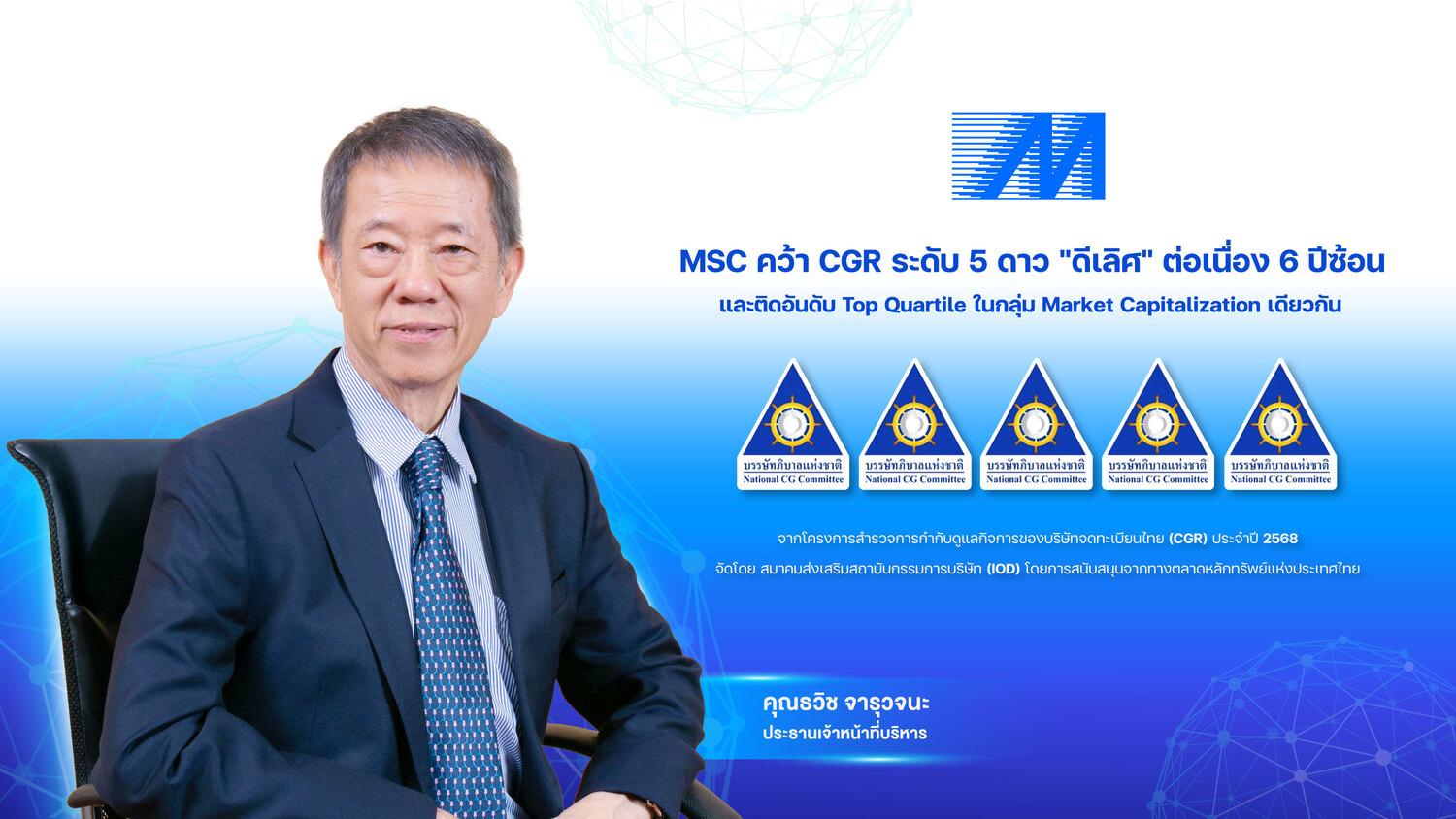
The Company received the results of the Corporate Governance Report of Thai Listed Companies (CGR) assessment for 2025 from the Thai Institute of Directors (IOD), supported by the Stock Exchange of Thailand and the Securities and Exchange Commission. The company achieved an overall score of 98 percent, rated as “Excellent,” and was placed in the Top Quartile among listed companies with a market capitalization between 1,501–3,000 million Baht.
In 2025, the company's scores increased in the categories of stakeholder consideration and sustainable business development, information disclosure and transparency, and board of directors' responsibilities. The scores for each category are as follows: 1) Shareholder Rights and Equitable Treatment of Shareholders, 2) Stakeholder Consideration and Sustainable Business Development, 3) Information Disclosure and Transparency, and 4) Board of Directors' Responsibilities, with average scores of 91 : 106 : 97 : 83 respectively, which is higher than the company's total score of 94 percent in 2024.
The Thai Investors Association announced the results of the quality assessment for the 2024 Annual General Meeting of Shareholders (AGM Checklist), where the company scored 100 percent. For the 2025 Annual General Meeting of Shareholders (AGM Checklist) quality assessment, the company scored 98.5 percent.
The Stock Exchange of Thailand announced the results of the 2025 assessment of investor relations performance for listed companies (Best Investor Relation Awards). For its investor relations operations, the company received a score of 80.44 percent.
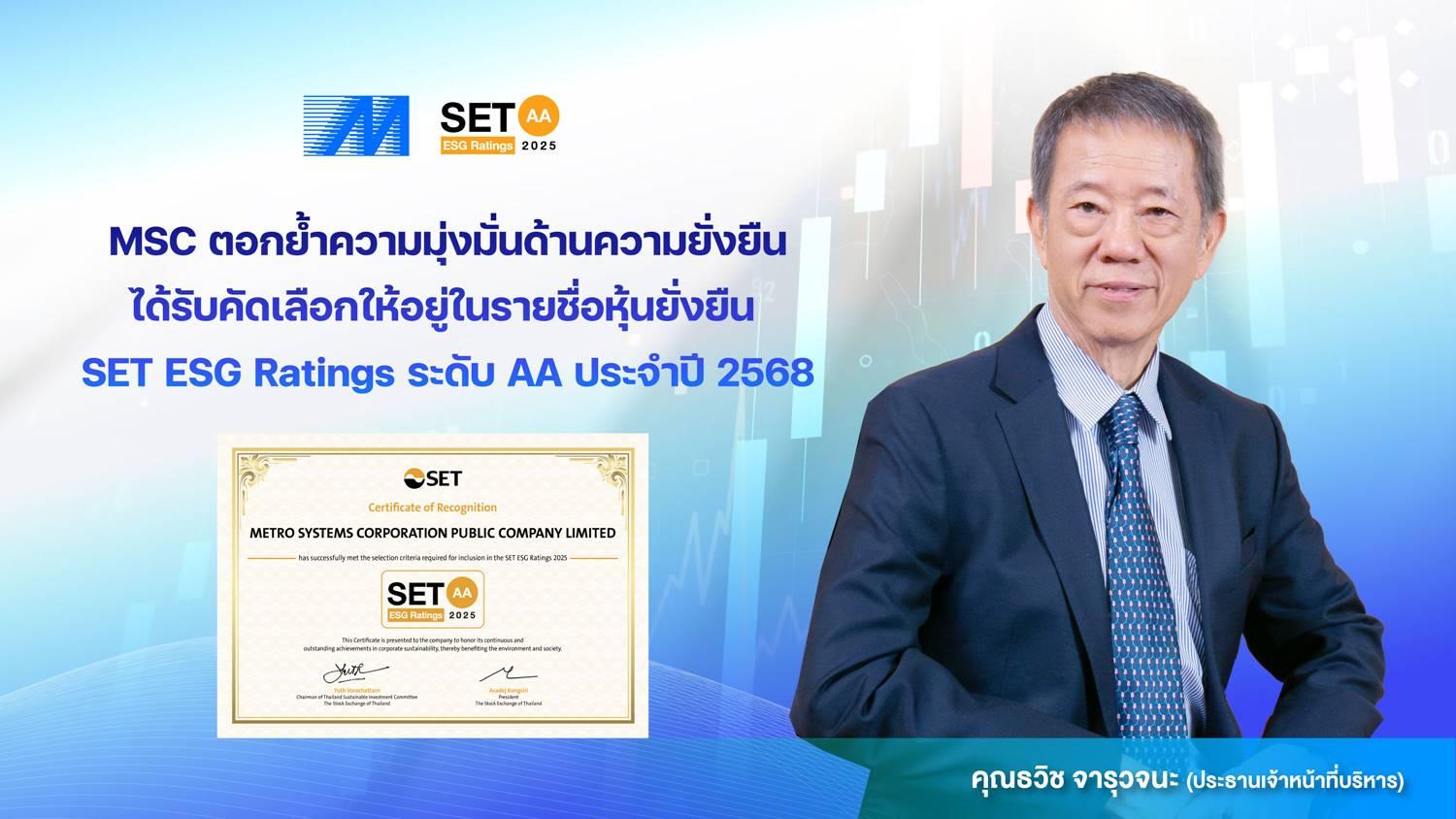
In 2025, the Company passed the Sustainable Stock Assessment (SET ESG Ratings) conducted by the Stock Exchange of Thailand. The assessment results showed that the company received an overall score of 84 percent, an increase from 74 percent in 2024. This resulted in the company being upgraded to an AA rating in the SET ESG Ratings, from its previous A rating.
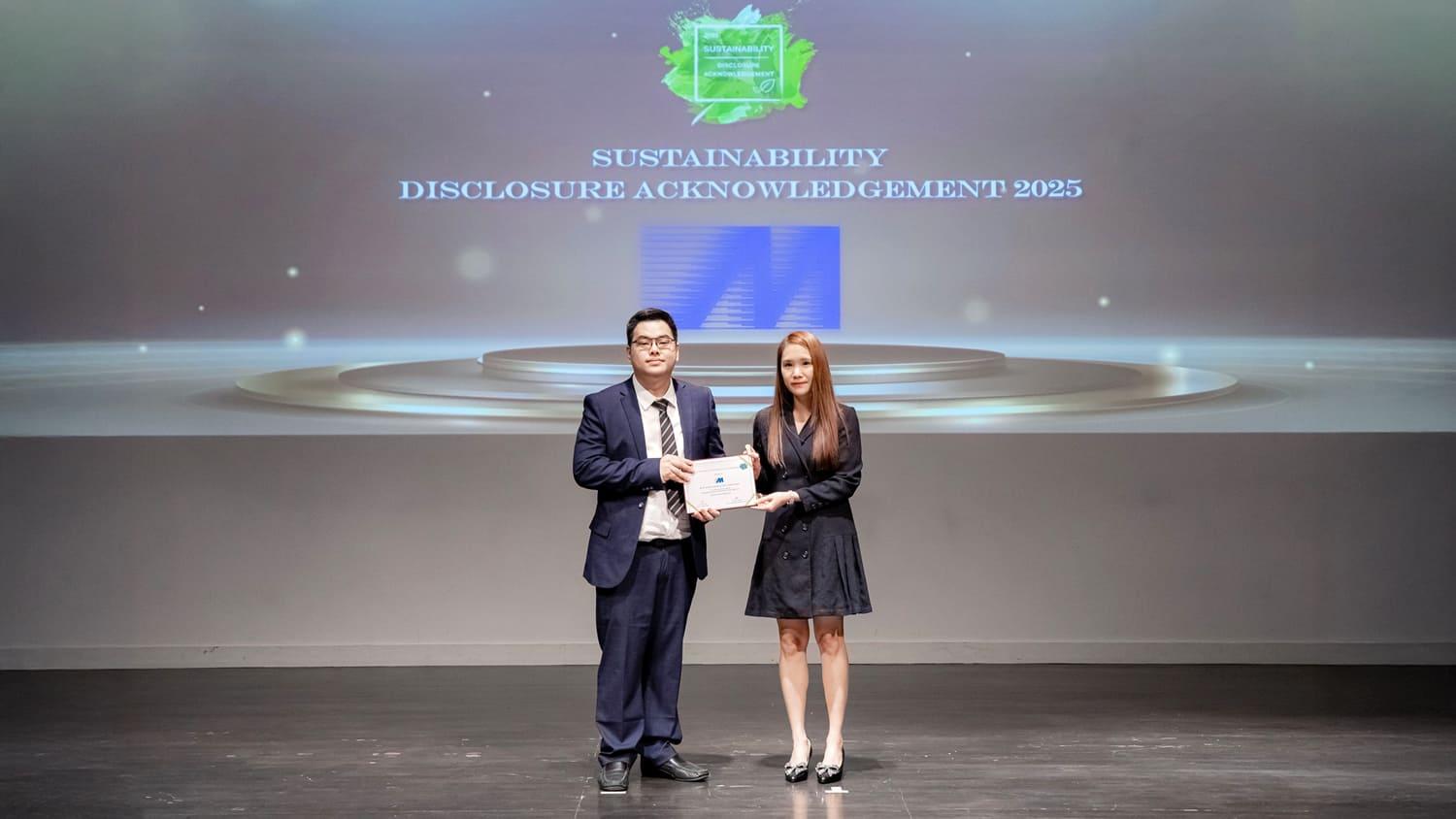
In 2025, Thaipat Institute selected the Company to receive the “Sustainability Disclosure Acknowledgement” for its continuous disclosure of sustainability information for the 6th consecutive year.